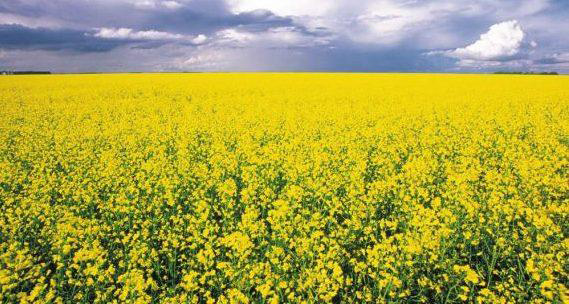
Rape is a technical agricultural crop that is highly sensitive to the lack of Boron, Molybdenum,Manganese and Calcium. Reacts very well to foliar feeding with fertilizers. In order to make the most of the genetically determined high yield of rape, it should be provided with all the necessary microelements.
Rape is a technical agricultural crop that is highly sensitive to the lack of Boron, Molybdenum,Manganese and Calcium. Reacts very well to foliar feeding with fertilizers.
In order to make the most of the genetically determined high yield of rape, it should be provided with all the necessary microelements.
For the formation of 1 ton of rapeseeds we need approximately 60-120 g of Boron, 60-150 g of Zinc, 100-300 g of Manganese, 10-40 g of Copper, 1-2 g of Molybdenum. However, the necessary microelements are not always in the soil in an accessible form. Pre-sowing treatment of seeds and foliar feeding will provide plants with necessary microelements.
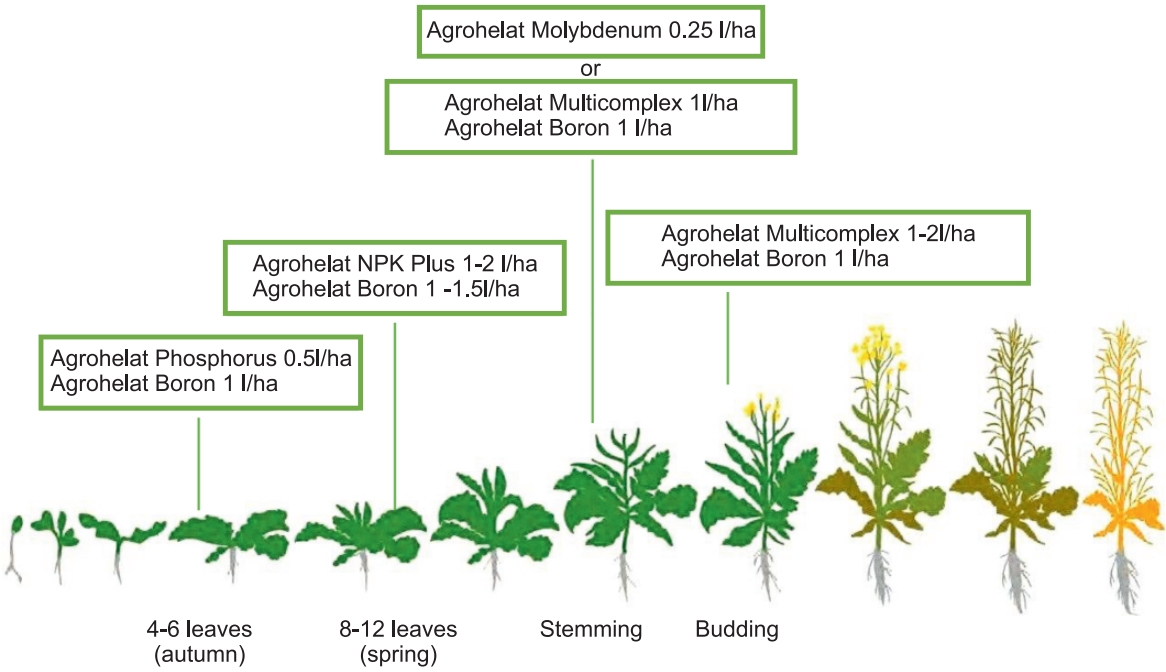
Changes in the feeding program are developed by the representatives of our company individually, based on the real needs of the plants on the farm. The following is taken into account: processing methods and the level of fertilization of the soil, the content of nutrients in the arable layer and the amount of the planned yield.
Pre-sowing treatment of rapeseeds with Agrohelat Molybdenum (1l/t) and Agrohelat Multicomplex (1 l/t) fertilizers will provide plants with necessary microelements from the moment of germination and make it possible to compensate for the early deficiency of Molybdenum in autumn, it will protect plants from the negative factors in winter. Plants need Molybdenum for nitrogen assimilation and protein formation. Lack of Molybdenum increases sensitivity to frost and contributes to the appearance of gray rot. During the vegetation period, the necessity of feeding with Molybdenum is determined by leaf diagnostics or by visual signs. Foliar feeding with Agrohelat Molybdenum (0.25 l/ha) is advisable if the Molybdenum content in the upper fully formed leaves of plants is below 0.3 ppm.
For rape, there are four crucial stages: the formation of a leaf rosette ( in autumn for winter rape), stem formation, tying and the development of buds, the end of flowering.
Treatment in autumn (for winter rape) in the phase of 4-6 leaves with Agrohelat Boron (1 l/ ha) and Agrohelat Phosphorus (0.5l/ha) affects the correct formation of the root neck and prepares the plant for winter, reduces the risk of frost damage and improves the resistance to fomosis.
It is recommended to carry out the first feeding in spring during the spring rosette phase (8- 12 leaves) with Agrohelat NPK Plus (1-2 l/ ha) and Agrohelat Boron (1-1.5 l/ha) fertilizers. After winter, the development of the root system is slowed down which decreases the absorption of nutrients from the soil. Foliar feeding with complex fertilizers will provide plants with all the necessary nutrients and activate physiological processes.
In spring, there is a rapid growth of roots and shoots which is accompanied by maximum cell division, as a result plants need more Boron and Calcium. The next feeding is carried out in the phase of stemming with Agrohelat Boron (1l/ha), Agrohelat Multicomplex (1l/ha) or Agrohelat Molybdenum (0.25l/ha) when the deficiency is detected.
Budding phase. After the formation of the optimal leaf cover, special attention should be paid to maintaining its health, since the formation of the maximum number of seeds depends on it. Nitrogen and Magnesium play an important part in preserving the leaf cover. Zinc and copper contribute to the formation of flowers, fertilization and seed formation. Agrohelat Multicomplex (1-2l/ha) and Agrohelat Boron (1l/ha) provide plants with the necessary nutrients, contribute to richer flowering, formation of a larger number of pods and seeds and increases the content of starch and other carbohydrates which are necessary for the rapeseeds to form oils and fats.